
To get recommended by ChatGPT, Google AI Overviews, and Perplexity, a local business needs three things: a consistent, verifiable identity (Google Business Profile, reviews, directories), a website that answers real customer questions directly, and earned mentions on sites AI already trusts. At LocalRankings, this is the work we do for local businesses every week, so this guide sticks to what the controlled studies actually show.
Key Takeaways
- 45% of consumers used AI tools like ChatGPT to find local businesses in the past year, up from 6% the year before (BrightLocal).
- AI engines recommend businesses they can verify: a complete Google Business Profile, consistent name and address everywhere, and detailed reviews.
- The biggest on-page win is answering real customer questions directly, backed by specifics AI cannot invent.
- Schema markup does not lift AI citations. A controlled study of 1,885 pages showed no meaningful movement (Ahrefs).
- Nobody can promise you a spot in an AI answer. Measure your visibility monthly instead of trusting guarantees.
How do AI tools like ChatGPT decide which businesses to recommend?
AI tools recommend businesses by synthesizing what the web already says about them: your Google Business Profile, your reviews, your website, and mentions on directories and local press. There is no submission form. The engine retrieves sources it trusts and summarizes them into an answer.
The research team that coined the term put it plainly in their KDD 2024 paper:
“Generative Engines typically satisfy queries by synthesizing information from multiple sources and summarizing them using LLMs.” (source: Aggarwal et al., GEO: Generative Engine Optimization)
That mechanism is the whole strategy. If the sources AI reads describe your business clearly and consistently, you can be recommended. If they conflict, or say almost nothing, you are invisible no matter how good your work is.
How many people actually use AI to find local businesses?
Nearly half of consumers now use AI for local recommendations, and adoption grew more than sevenfold in a single year.
BrightLocal’s 2026 Local Consumer Review Survey found 45% of consumers used tools like ChatGPT, Gemini, or Perplexity to find local businesses in the past year, up from 6% a year earlier (BrightLocal).
The same survey found adoption highest among 30 to 44 year olds at 64%. That is the homeowner demographic hiring HVAC companies, plumbers, roofers, and med spas. AI recommendations are no longer a fringe channel for local service businesses; they are the third discovery channel behind Google and Facebook.
What is generative engine optimization (GEO), and how is it different from SEO?
Generative engine optimization (GEO) is the practice of making your content retrievable and citable inside AI-generated answers. Classic SEO earns you a ranked blue link. GEO earns you a mention or citation inside the answer itself. The two overlap heavily, but they reward different structures.
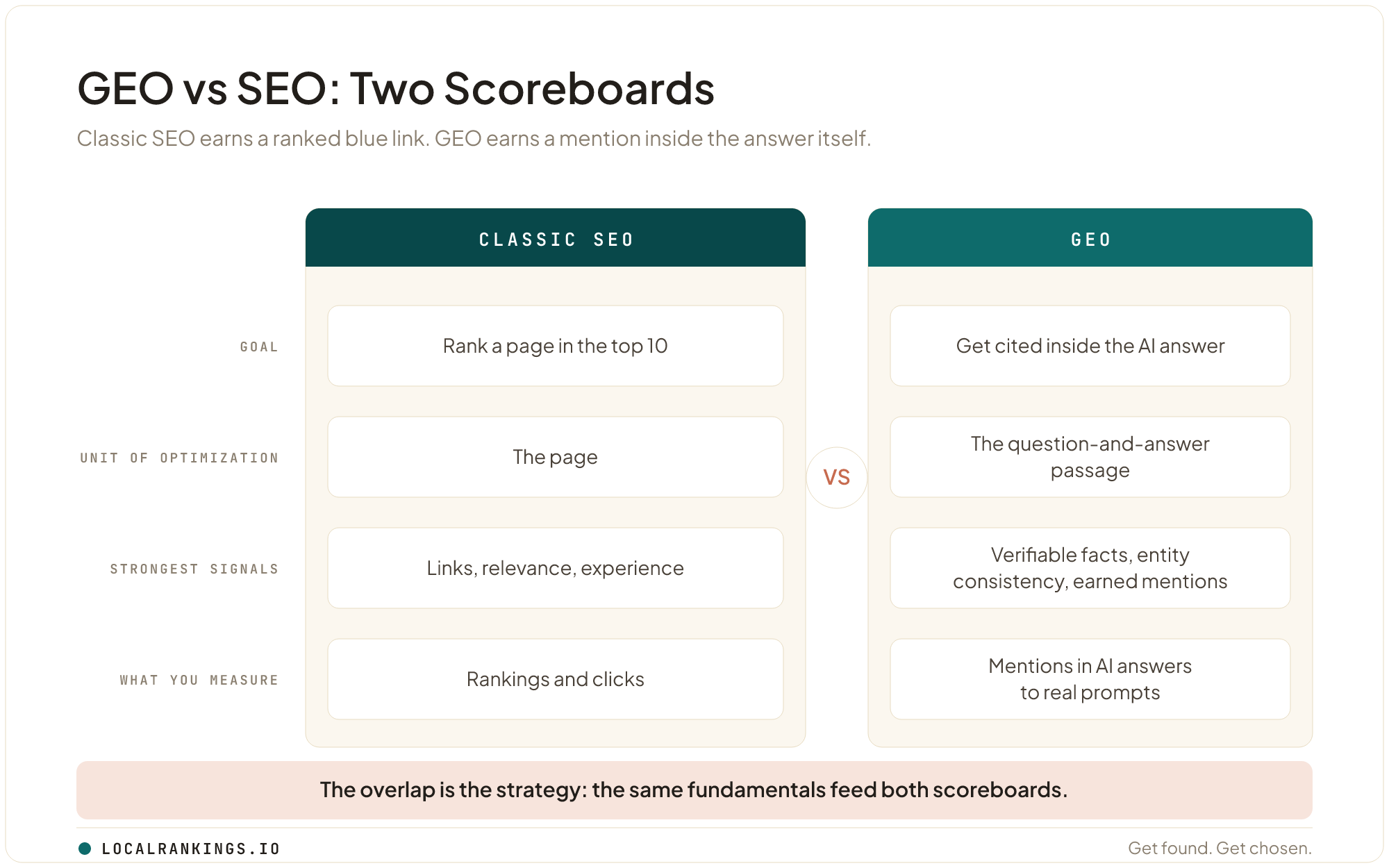
| Classic SEO | GEO | |
|---|---|---|
| Goal | Rank a page in the top 10 | Get cited inside the AI answer |
| Unit of optimization | The page | The question-and-answer passage |
| Strongest signals | Links, relevance, experience | Verifiable facts, entity consistency, earned mentions |
| Result you can measure | Rankings and clicks | Mentions in AI answers to real prompts |
The academic evidence says structure matters: “we demonstrate that GEO can boost visibility by up to 40% in generative engine responses,” according to the same Aggarwal et al. study. The tactics that worked were citing sources, quotations, and statistics, while keyword stuffing lowered visibility.
Does my Google Business Profile affect whether ChatGPT recommends me?
Yes. For local queries, your Google Business Profile is one of the first structured sources AI systems lean on for your hours, categories, services, and reviews. An incomplete or stale profile starves the engine of the exact facts it needs to recommend you confidently.
Treat the profile as your machine-readable storefront: accurate primary category, every real service listed, current hours, photos, and a website link. Then keep your name, address, and phone number identical across your site, directories, and social profiles. Inconsistent listings force the engine to guess, and engines do not recommend businesses they have to guess about.
Do reviews matter for AI recommendations?
Yes, and not only as star ratings. Reviews are text the models actually read. Detailed reviews that name the service, the city, and the outcome (“replaced our AC in Spring Hill the same week”) teach the engine what you do, where you do it, and who you serve well.
A steady flow of specific reviews does double duty: it feeds AI answers and it remains one of the strongest local ranking signals in Google Maps. The practical move is simple and legal: ask every customer for a review, ask them to mention the service and city, and never gate or filter who you ask.
Does schema markup help you get cited by AI?
No. Adding schema markup is the most common piece of GEO advice, and the controlled evidence says it does not lift AI citations.
Ahrefs tracked 1,885 pages that added JSON-LD schema against 4,000 matched control pages. AI Overview citations moved minus 4.6% and ChatGPT citations moved plus 2.2%, both indistinguishable from noise (Ahrefs).
The reason is mechanical: AI systems extract the visible text of your page, not the hidden code block. Schema still has one durable use, disambiguating your business identity for knowledge graphs. Set up basic Organization or LocalBusiness markup once, then spend your hours on content and reviews instead.
What should be on my website so AI can actually cite it?
Your website should answer, in plain visible text, the exact questions customers ask AI about your service. Your own domain is the anchor for everything else the engines read about you.
“Your owned domain appears as the #1 cited source 87% of the time when your brand gets mentioned.” (source: Algomizer, from an analysis of 169,000 AI visibility prompts)
Build each service page around that:
- State who you are, what you do, and the exact areas you serve in the first paragraph.
- Use real customer questions as headings, then answer each in the first sentence or two.
- Include verifiable specifics: your license number, years in business, real project details.
- Keep prices or price ranges honest and current, or omit them.
- Show a visible published or updated date and keep the page fresh.
How do I check if AI already mentions my business?
Ask the engines the same questions your customers ask, and write down what comes back.
Open ChatGPT, Perplexity, and Google (for AI Overviews) and prompt things like “best [your service] in [your city]” and “who should I call for [problem] in [city]”. Record whether you are named, who is named instead, and which sources the answer cites.
Do this monthly with the same prompt list. The cited sources are your to-do list: if the engine keeps citing a directory or a “best of” list you are not on, earning a spot on that page is your next move.
How long does it take to show up in AI answers?
There is no reliable timeline, and anyone quoting one is guessing.
AI answers rebuild themselves constantly, engines reshuffle which sources they cite, and a business cited this month can drop out next month. That volatility cuts both ways: it also means new, well-structured pages can surface faster than they would in classic organic rankings.
The honest posture is baseline and re-measure. Record where you stand today with the monthly prompt check above, do the foundational work, and judge progress on the trend across months, not on any single answer.
Is GEO worth it for a small local business, or should I fix SEO first?
Fix the local SEO foundation first, because it is the same work as GEO.
Your Google Business Profile, review flow, consistent citations, and service pages that answer real questions power both Google Maps rankings and AI recommendations. GEO is not a separate project to buy; it is a structure to apply to work you should be doing anyway.
Proximity data makes the same point. Local Falcon’s study of Google AI Overviews found businesses closer to the searcher appeared in AI results 72.0% of the time versus 68.5% for those farther away (Local Falcon), an echo of how the local pack already works. The playbook that wins Maps is the playbook that wins AI, executed with answer-first content.
If you want to know where your business stands in AI answers today, LocalRankings runs that baseline as part of every local visibility audit.
FAQ
Can you pay ChatGPT or Google to recommend your business? No. There is no paid placement inside organic AI answers today. Ads may appear around them, but the recommendation itself is synthesized from sources the engine trusts, which is why the work above matters.
Does distance from the searcher matter in AI Overviews? It influences whether you appear at all. Local Falcon measured nearby businesses appearing 72.0% of the time versus 68.5% for farther ones (source). You cannot move your shop, but you can strengthen every other signal.
Which AI engine matters most for a local business? Google AI Overviews, because they sit on top of the searches your customers already make. ChatGPT and Perplexity are growing fast, but the same foundation feeds all of them, so you do not need separate strategies.
Do I need different content for each AI engine? No. Every major engine rewards the same structure: clear entity information, visible question-and-answer content, and verifiable specifics. Write once, correctly, and measure across engines.