
A customer in your town pulls out their phone tonight and asks a question they used to type into Google. Except they don’t type it into Google anymore. They ask ChatGPT: “who’s a good plumber near me that can come out tomorrow morning?” And they don’t get ten links to scroll through. They get a short paragraph that names one or two companies and moves on. Everyone else, as far as that customer is concerned, doesn’t exist.
That moment is what everyone in marketing is suddenly calling GEO. And depending on who you ask, it’s either the most important thing to happen to local search since Google Maps, or a brand-new acronym invented to sell you a brand-new monthly fee.
The honest answer is in between. So here’s the version we’d give a friend who owns a shop.
The short version
If you only have ninety seconds: you do not need to buy “GEO.” You need to tighten the same local fundamentals that already win you Google, because those are exactly what the AI reads too. Do these six things and you win the AI answer, the map pack, and the customer who never used AI at all, all at once:
- Make your name, address, and phone identical everywhere online.
- Treat your Google Business Profile as a living page, not a billboard.
- Get your reviews over 4 stars, and reply to every one.
- Earn a few mentions on sites you don’t own (a “best-of” list, the local paper, your chamber).
- Write one plain, honest page for each service you offer.
- Measure what books jobs, not what flatters you.
That’s GEO for a local business, minus the hype. The rest of this explains what it is, where it’s real, where it’s a scam, and why those six things are the whole game.
What GEO actually is
Generative Engine Optimization (GEO) is the practice of making your business easy for an AI answer engine (ChatGPT, Google’s AI Overviews, Perplexity, Gemini) to understand, trust, and name when it generates a recommendation. Where classic SEO earns you a ranked link in a list, GEO earns you a mention inside a single synthesized answer.
That’s the whole idea. The customer used to get a list and pick from it. Now a machine reads the list for them and hands back one answer, and your job is to be the business it names.
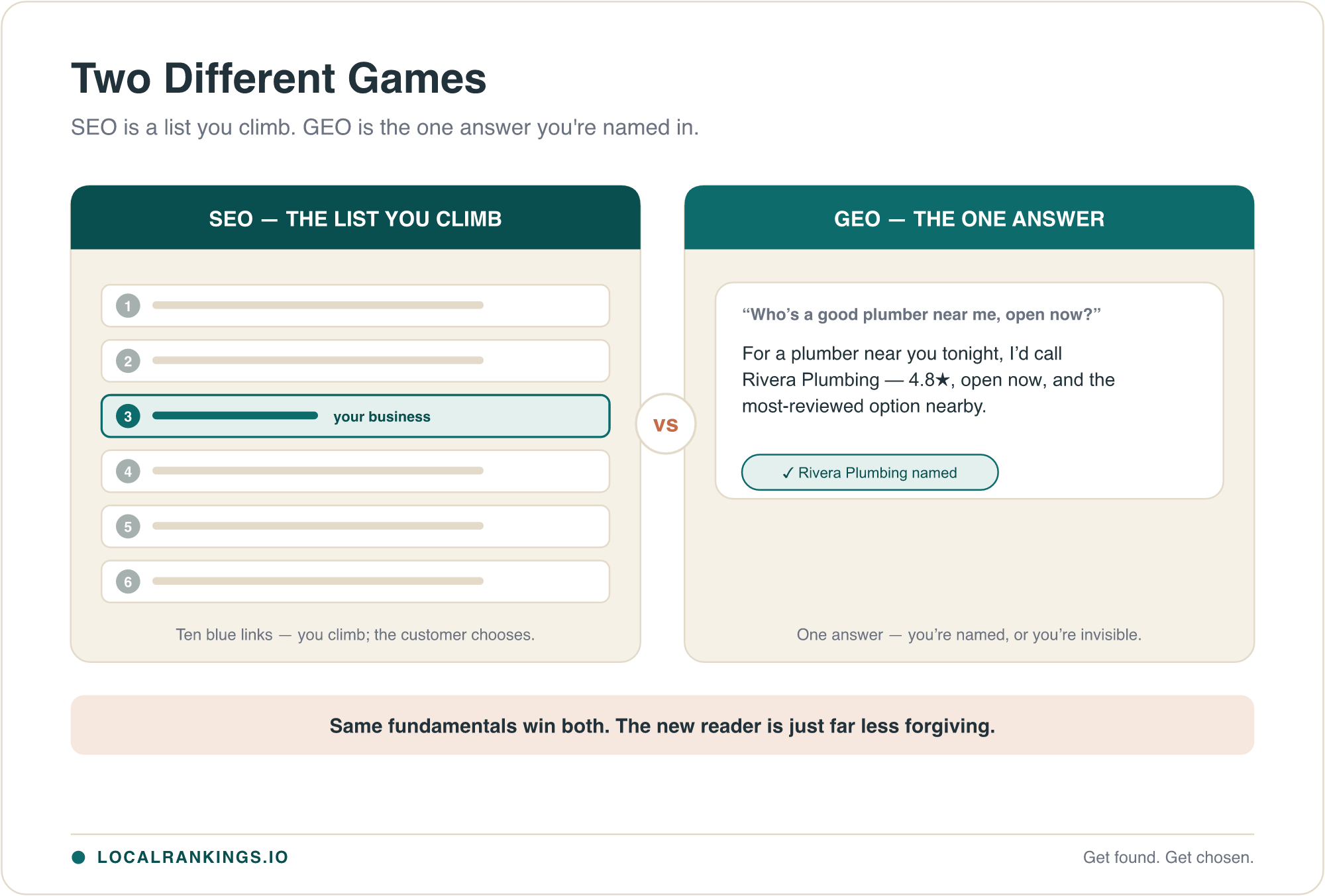
Two different games: SEO is a list you climb; GEO is the one answer you’re named in.
The term isn’t marketing slang, for the record. It comes from a 2023 research paper out of Princeton (with Georgia Tech, IIT Delhi, and the Allen Institute for AI) titled “GEO: Generative Engine Optimization.” The researchers tested which tactics made a source more likely to get pulled into an AI answer, and the winners were unglamorous: adding citations, quotations, and real statistics to your content. Keyword stuffing actually hurt. You’ll see that paper quoted everywhere as “GEO boosts visibility by up to 40%.” Worth knowing that 40% was a best-case result for one tactic in one category, not an average and not a promise. Hold onto that number; it comes back later as the setup for a scam.
GEO vs SEO, and the part that’s the same
The difference is real but simple. SEO is about climbing a list, where the customer does the choosing. GEO has no list to climb: there’s one answer, and you’re either named in it or you’re invisible. You’re not optimizing your rank: you’re trying to be the name the machine repeats.
Here’s the part the honest people in our industry keep saying out loud, though: for a local business, GEO is mostly not a new discipline. Google’s own documentation flat-out says optimizing for its AI features “is still SEO,” and warns business owners to be skeptical of anyone selling separate “GEO” or “AEO” services. The fundamentals didn’t change. What changed is that the new reader is less forgiving. The old list could bury a sloppy, inconsistent business on page two, where a determined customer might still scroll down and find it. The AI just leaves that business out of the answer entirely. Same work as before: higher cost for skipping it.
Why a local business should (and shouldn’t) panic
Let’s be straight about where this actually stands, because the hype gets it wrong in both directions.
First, the calm-down. For local businesses, the Google map pack still owns discovery: the vast majority of “near me” searches still run through classic Google results, and the top three map spots take the lion’s share of the clicks. AI search is still under 1% of most sites’ traffic. And here’s the detail that undercuts the panic: AI Overviews barely show up for the searches that actually book you work. They fire on something like 90–100% of informational questions (“how does a tankless water heater work”) but only an estimated 6–10% of commercial, “near me,” ready-to-book searches. The person with a burst pipe at 9pm isn’t reading an AI essay. They’re tapping the first number in the map pack.
So no, ChatGPT is not currently eating your booked jobs.
Now the reason it’s still worth your attention: the trend line is real and steep. In BrightLocal’s 2026 survey, 45% of consumers said they’d used AI for a local recommendation at least once, up from 6% a year earlier. (Read that as “two in five have tried it,” not “rely on it”; it’s a low bar, but it points one direction.) The people who do find a business through an AI show up readier to buy, because the AI already pre-screened the options for them.
And there’s one finding worth pinning to the wall, because it’s what makes GEO more than a rebrand: getting recommended by AI is a separate contest from winning the map pack. When researchers checked, only about 45% of the businesses winning the local 3-pack were also the ones AI recommended. Sterling Sky, looking across roughly 322 markets, found Google’s AI names only about a third as many businesses as the old 3-pack did, a tighter, winner-take-most door. Walking through the map-pack door doesn’t automatically walk you through the AI one.
We see that gap directly. A shop can sit second in the map pack and still go unnamed when someone asks ChatGPT for a recommendation, usually because its reviews are thin, or because nobody outside its own website vouches for it, so the AI has nothing to repeat. The map pack rewarded it for being close; the AI wanted corroboration it couldn’t find. That’s the whole thing in one line: proximity gets you onto the map, but consensus gets you into the answer. (We keep a running set of GEO insights tracking exactly that gap.)
The takeaway isn’t “drop everything and chase AI.” It’s that the work winning the AI answer is the same work winning the map pack, and right now, doing it well gets you both doors.
The honest part: what GEO is not
This is where the selling happens.
GEO is not a schema tag. The most common GEO pitch is “add structured-data markup to your site and the AIs will start citing you.” It sounds technical and true. It mostly isn’t. Ahrefs ran a controlled study: 1,885 pages that added schema markup, measured against 4,000 similar pages that didn’t, over about seven months. For pages already in the AI’s consideration set, adding schema produced no meaningful lift in citations on any platform. Google’s AI Overviews actually ticked down slightly. In a separate test, someone put a product’s price only in the schema markup and asked five different AI systems to find it. None could. They read the visible words on your page, not the code hidden behind it. Schema still earns you classic rich results and keeps your business details straight across the web, which is worth doing. It is just not the magic AI button it’s sold as. For a local shop, that distinction is money: schema is a one-time setup your web person can do in an afternoon, not a recurring “GEO optimization” line item worth hundreds a month. Pay for the setup once if you want it. Don’t rent it.
GEO is not the “Princeton 40%.” Remember that number? The vendors who quote it almost always pair it with “so let us add schema and AI-optimize your pages.” But the paper never tested schema. The tactics it found that worked were adding real citations, statistics, and clear quotable answers to your content, in other words, writing genuinely useful pages. There’s no shortcut hiding in that study.
GEO is probably not a separate retainer. When an industry invents a new acronym and instantly attaches urgency and a premium price to it, that pattern is itself the warning sign. Google’s own search team has flagged exactly that move. For most local businesses, GEO isn’t a product to buy on top of everything else. If someone quotes you a big monthly number to “do GEO,” ask them to show you the part that isn’t just good local SEO with a new name.
Curious whether AI is naming your business, or your competitor’s? We’ll show you on a free local audit, then lay out exactly what to fix first. About 30 minutes, no obligation.
What actually gets a local business named by AI
So if it’s not schema and not a secret tactic, what does move the needle? The serious sources here (Whitespark’s 2026 expert survey, SOCi’s index of 350,000+ business locations, citation analyses from tools like ZipTie) point the same direction.
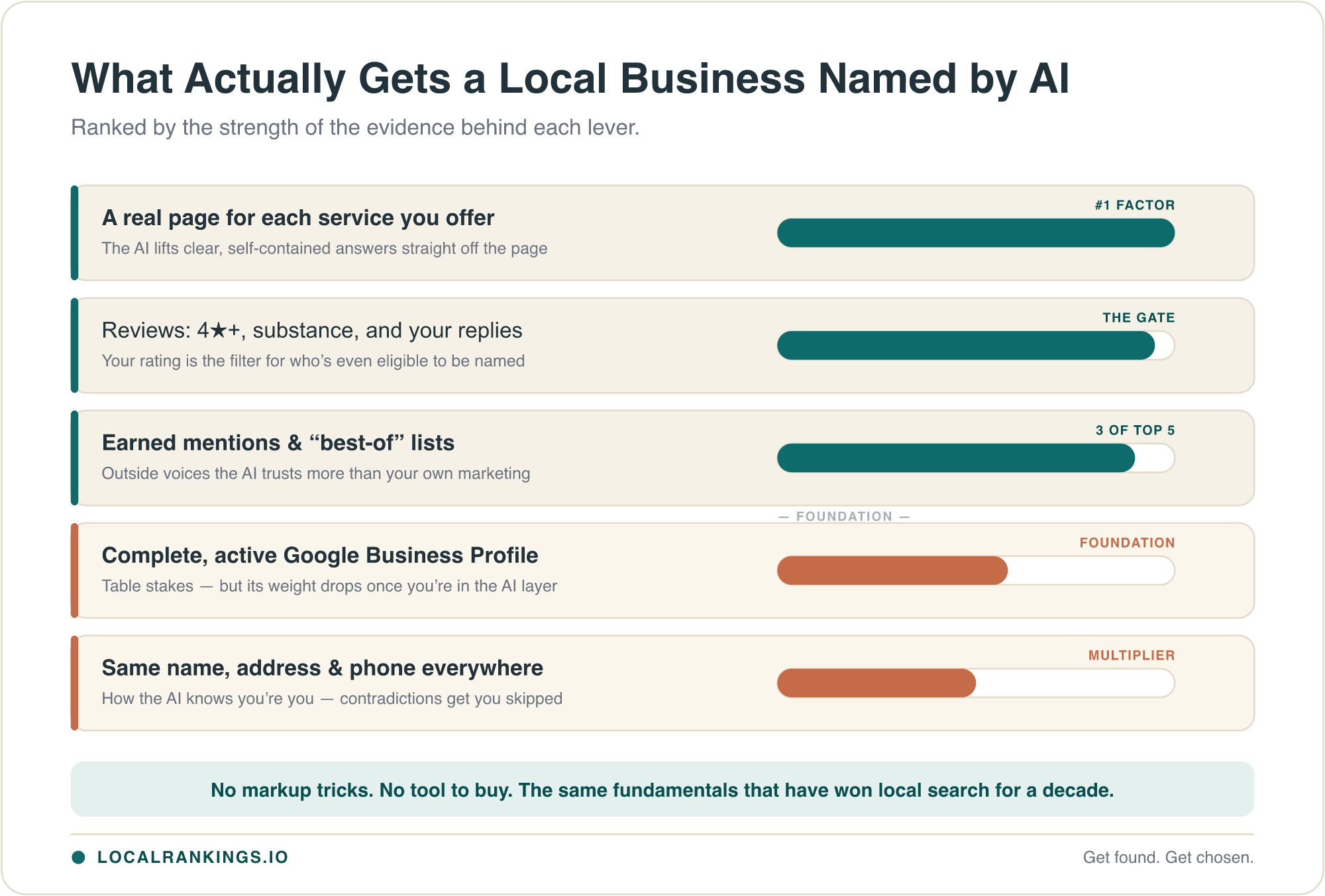
The levers that move AI visibility for a local business, ranked by the strength of the evidence behind them.
| Lever | Why the AI cares | How strong the evidence is |
|---|---|---|
| A real page per service, written to answer the question | The AI lifts clear, self-contained answers straight off the page. Whitespark’s experts rank on-page content the #1 AI-visibility factor, well above its weight in the classic map pack. | Strong: top factor across sources |
| Reviews: rating, substance, recency, and your replies | AI uses your star rating as a filter for who’s even eligible. SOCi found AI-recommended businesses averaged about 4.3 stars, while businesses under ~3.4 stars with few owner replies were effectively invisible. | Strong: the most cross-validated lever |
| Earned mentions: “best of” lists, local press, directories | The AI trusts what other credible sites say about you more than what you say about yourself. In Whitespark’s data, three of the top five AI factors are some form of outside mention. | Strong: biggest structural finding |
| A complete, active Google Business Profile | Still table stakes (Google’s AI is grounded in Maps) but its weight drops once you’re in the AI layer. Necessary, not sufficient. (Roughly 65% of small businesses still haven’t fully claimed theirs, so it’s usually the highest-ROI first move.) | Strong as a floor, weaker as an edge |
| The same name, address, and phone everywhere | This is how the AI knows you’re you. If those details disagree across Google, Yelp, and Facebook, the AI gets confused and skips you. Assistants were only about 68% accurate on business details in one test. | A multiplier on everything above |
Notice what’s not on that list: no markup tricks, no acronym, no tool you have to buy. It’s the same short list of fundamentals that has decided who wins local search for a decade. The AI reader just made them matter more and made sloppiness more expensive. If you only have time for one row, make it the reviews: it’s the fastest to move, and it’s the gate the AI checks before it will even consider naming you.
Where AI shows up, and where it doesn’t
One more picture, because it reframes the whole “should I panic” question.
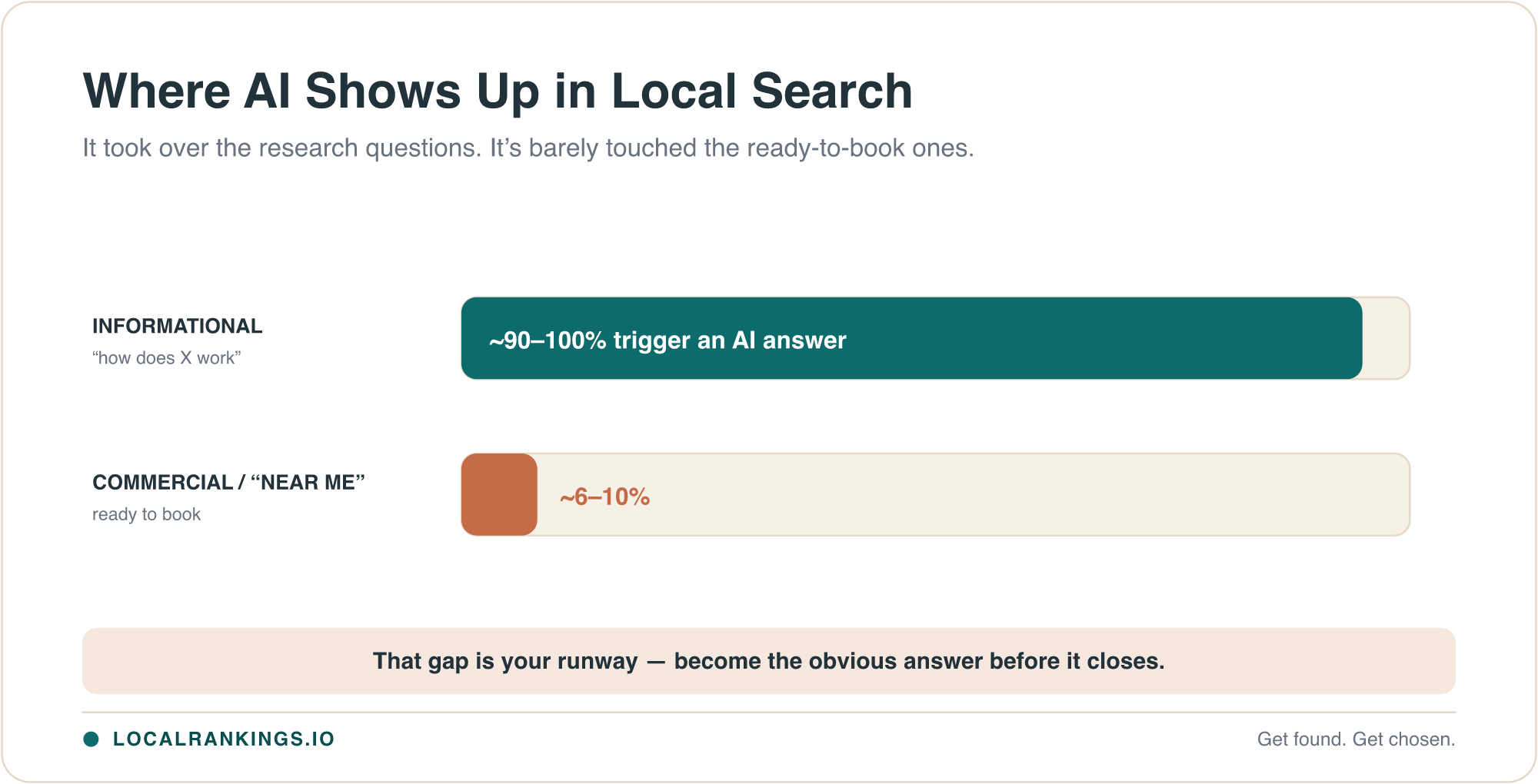
AI has taken over the research questions and barely touched the ready-to-book ones, for now.
The questions AI owns are the how and why ones, where someone’s learning, not buying. The questions it’s barely touched are the who do I call right now ones, where the money is. That gap is your runway. It’s why you don’t need to panic, and also why ignoring this entirely would be a mistake, because the gap is closing, and the businesses building their fundamentals now will already be the obvious answer when it does. (This is the same shift we wrote about in “AI Search Is a New Layer on Top of Google”: the AI isn’t a new place to rank, it’s a new reader sitting on top of the search that already existed.)
And it won’t stay on screens. That same one-name answer is what Siri, Alexa, and Google Assistant read aloud when someone asks out loud for “a good electrician near me.” And a spoken answer has room for exactly one business, not a list of ten. The runway isn’t just time before AI takes more of your screen; it’s time to become the obvious, consistent, well-reviewed answer before the assistants start saying one name and it isn’t a coin flip whether it’s yours.
What to do this quarter
You don’t need a “GEO strategy.” You need your local fundamentals tight enough that the AI has no reason to skip you. Same six from the top, now with the first step for each:
-
Make your facts agree everywhere. Your name, address, phone, hours, and services should read identically on Google, your website, Yelp, and Facebook. Monday: pull up your own Google, Yelp, and Facebook listings side by side and fix the first contradiction you find.
-
Treat your Google Business Profile as a living page. Fill every field, post regularly, keep photos current, answer questions. A profile frozen for a year reads as a business that might be closed.
-
Get your reviews over 4 stars, and reply to them. This is the single most repeatable lever, because it’s the bar the AI uses to decide who’s even eligible. Monday: ask your three happiest recent customers for a review, and reply to every review you already have.
-
Earn a few mentions you don’t own. A “best [your trade] in [your town]” list, a local news mention, a chamber listing: the outside voices the AI trusts more than your own marketing. Monday: email your local chamber of commerce to get listed, and ask one community blog or supplier to mention you. (Earning that outside authority is the slow, durable half of how we get businesses found.)
-
Write one honest page per service that answers the real question. Not keyword soup: a plain page a person (and an AI) can lift a sentence out of, like “what does emergency AC repair cost in Tampa, and how fast can you come out?”
-
Measure what books jobs, not what flatters you. Getting named by an AI is nice; getting a phone call is the point. Monday: add “How’d you hear about us?” to your intake script so you actually know where customers come from.
Every one of those wins you the AI answer, the map pack, and the customer who never used AI at all. That’s the tell that you’re doing real work instead of chasing an acronym, the same effort pays off in three places at once, whether you run a med spa or an HVAC company.
Quick answers
Is GEO the same as AEO or “AI SEO”? Mostly, yes. They’re competing labels for the same idea: getting named in AI-generated answers. AEO (“answer engine optimization”) leans toward direct-answer features; “GEO” is the broader term that’s winning out. Don’t let anyone charge you separately for each acronym, it’s one job.
Do I have to pay someone to “do GEO” for my business? For most local businesses, not as a separate service. The work that wins AI answers is the same local SEO work that wins the map pack: consistent listings, strong reviews, a complete Google Business Profile, and a few earned mentions. If you’re already doing that well, you’re already doing GEO. If you’re not, fix that first: that’s the whole return.
Will AI replace Google for finding local businesses? Not soon. AI is taking over the research questions, but the ready-to-book “near me” searches still run through Google Maps and the map pack, and that’s where most of your revenue comes from today. The smart play isn’t to bet on one or the other; it’s to win both, which the same fundamentals do.
The bottom line
GEO is real, and GEO is oversold, and both are true at the same time. It’s real because the way people find local businesses is genuinely shifting, and the new door is narrower than the old one. It’s oversold because most of what’s marketed as “GEO” is either ordinary local SEO with a markup, or an outright myth like the schema pitch.
The move is neither to panic nor to ignore it. It’s to do the unglamorous fundamentals so well that you’re the obvious business to name: to a customer, to the map pack, and to the machine reading both. We’ve always said missed calls are a marketing problem disguised as a phone problem: you spend to get found, then leak the lead at the last step. GEO is that same lesson moved one floor up. Fix the leaks in your story before you spend chasing a new acronym, and you win the new game for the same reason you’d have won the old one.
Get found. Get chosen. That part never changed. If you want to know which of those six fundamentals is leaking on your business right now, that’s exactly what a free audit will tell you.