
A phone rings while you’re under a truck, or finishing a facial, or already on another call. By the time you get to it, it’s gone to voicemail. And the caller is already dialing the next business on the list. You’ll never know that call happened. That’s the thing about missed calls: the ones that cost you the most are the ones you never see.
So how much is that actually costing you? The honest answer is probably less than the scary numbers floating around, and more than you’d guess. Let’s figure out your real number instead of borrowing someone else’s.
The number you’ll see everywhere (and shouldn’t trust)
Search “cost of missed calls” and you’ll get confident figures: 85% of people who reach voicemail never call back; the average small business loses six figures a year. Those numbers get repeated everywhere, almost always by companies selling you something to fix it.
Here’s the problem: they mostly trace back to each other, not to any solid study. They’re vendor folklore. We’re not going to hand you one and pretend it’s measured, because the truth is your number depends entirely on your business: how many calls you miss, how often those callers actually buy, and what a job is worth to you. A missed call costs a plumber doing $8,000 repipes something very different than it costs a salon booking $40 cuts.
What the real research actually says
There’s a different body of evidence that is solid, and it’s more useful. It’s not about the call you missed: it’s about how fast you answer the ones you catch.
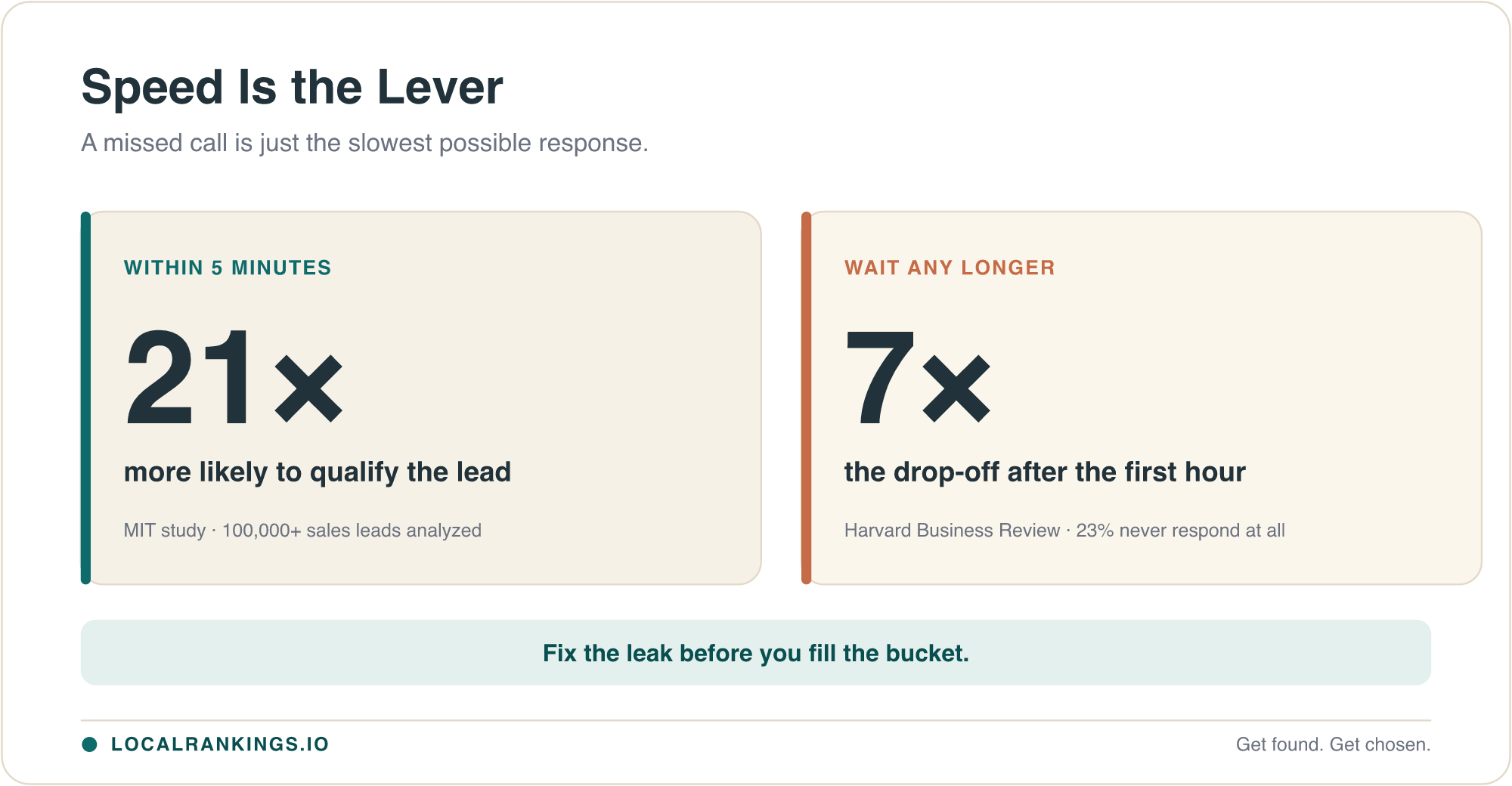
A landmark MIT study of more than 100,000 sales leads found that contacting a new lead within five minutes instead of thirty made a business 21 times more likely to qualify it. Wait longer and the odds fall off a cliff. Harvard Business Review’s audit of thousands of companies found the same shape: firms that responded within an hour were seven times more likely to have a meaningful conversation with a decision-maker than those who waited just an hour longer. And a remarkable 23% of leads were never contacted at all.
Read that again, because it reframes the whole problem. The expensive thing isn’t only the call you sent to voicemail. It’s the lead you did catch but got back to two hours later, after they’d already booked someone else. Speed is the lever. A missed call is just the slowest possible response time.
Run your own number
Forget the six-figure stat. Here’s a back-of-the-napkin version you can actually trust, because the inputs are yours:
- Missed calls a week. Check your phone’s call log or ask your team honestly. Say it’s 10.
- How many would’ve become customers. Not all of them: some are wrong numbers, vendors, or existing clients. A fair estimate for a service business is that roughly 1 in 4 new callers would book. Call it 2–3 a week.
- What a customer is worth. Use your average job, or better, what they’re worth if they come back. Say $300.
Ten missed calls a week, two-ish that would have booked, at $300 each, is somewhere around $1,800–$2,700 a month walking out the door, for one location. Your numbers will be different, and that’s the entire point: it’s your leak, measured, not a statistic you borrowed.
What to actually do about it
You don’t need to answer every call yourself. You need the calls to get answered, fast, and ideally around the clock. In order:
-
Find your real number first. Track missed calls for two weeks before you spend a dollar fixing it. You can’t improve what you’re not measuring, and you might be surprised which hours leak most. For a lot of trades it’s evenings and weekends, exactly when no one’s at the desk.
-
Close the after-hours gap. Most missed-call revenue leaks when you’re closed, on a job, or slammed. A simple missed-call text-back (“Sorry we missed you, how can we help?”) recovers a chunk of it. A 24/7 AI receptionist that actually answers, qualifies, and books recovers a lot more. It’s the kind of thing we set up for clients so the phone never goes to voicemail in the first place.
-
Fix the leak before you spend more on ads. This is the one that matters most. If you’re paying for Google Ads, local SEO, or showing up in AI answers to make the phone ring, every missed call is money you already spent, leaking out the bottom. There’s no point pouring more leads into a bucket with a hole in it. (A 24/7 AI receptionist is one way to plug it.)
The bottom line
The real cost of a missed call isn’t a number off a vendor’s homepage: it’s whatever your own missed calls, close rate, and job value add up to, and the speed math says it’s bigger than the single lost call. We’ve said for years that missed calls are a marketing problem disguised as a phone problem: you spend to get found, then lose the lead at the last step.
Figure out your number. Then fix the leak before you fill the bucket. If you want help measuring where your calls are actually leaking, and plugging it, that’s a conversation worth having.