
You search your own service in your own town, and three businesses show up in that little map box at the top. And you’re not one of them. It’s one of the most frustrating things in local marketing, partly because the rules are rarely spelled out. So here they are, honestly, including the one that stings: one of the biggest factors is something you can’t change at all.
What the map pack actually is
That box of three businesses with the little map is the “local pack,” sometimes called the 3-pack. It isn’t the regular blue links below it. It’s Google’s pick of the most relevant nearby businesses for a local search, and it’s prime real estate. For “near me” and “[service] in [city]” searches, it’s often the only thing people look at. And that intent is real money: Google’s own research has found that about half of the people who run a local search on their phone go on to visit a business within a day. Miss the box and you miss that visit.
The factor you can’t control (and why that’s freeing)
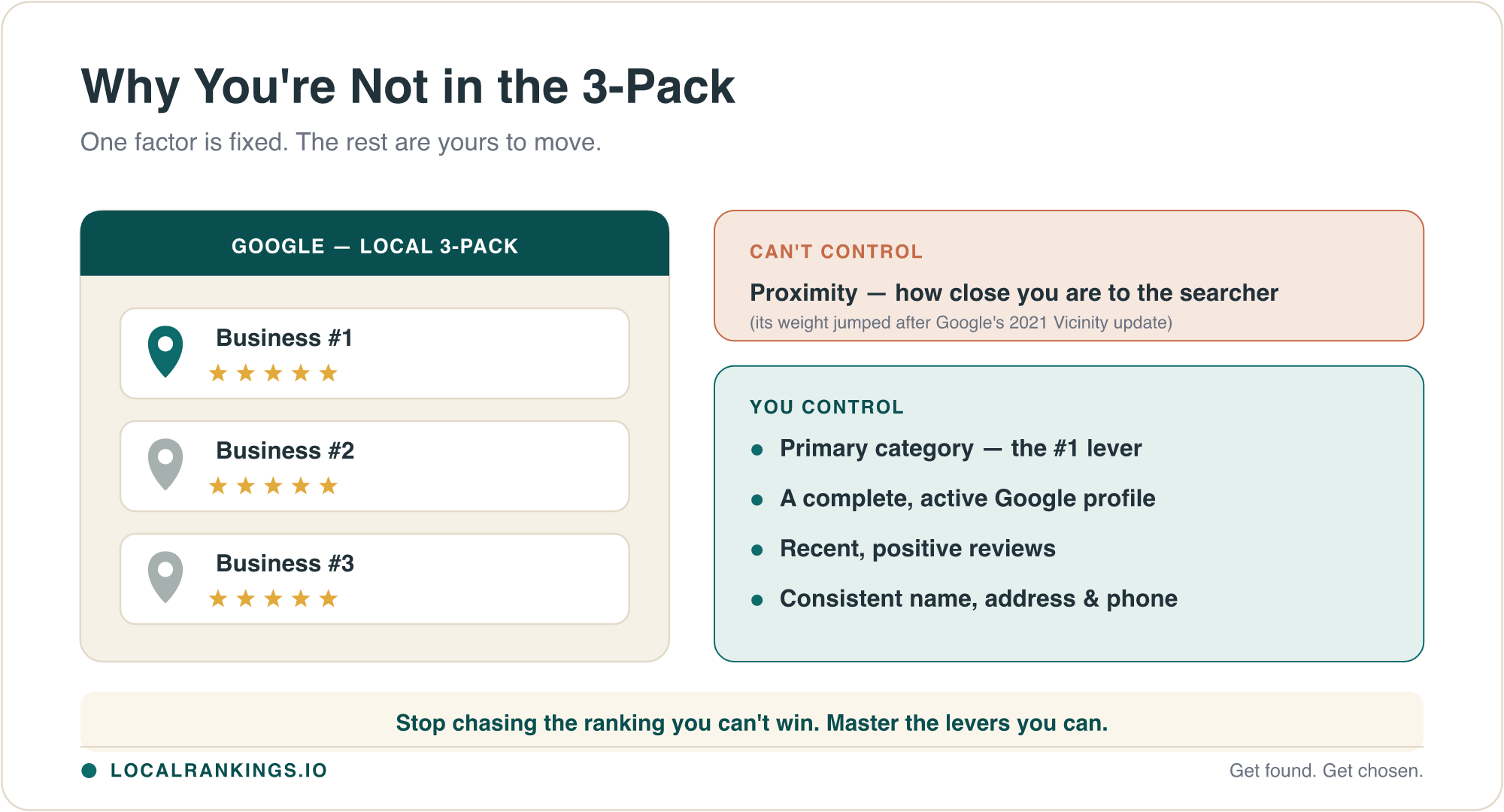
Here’s the honest part. One of the top-three things Google weighs for the map pack is proximity, how close your business is to the person searching, or to the center of the area they’re searching. According to Whitespark’s local ranking factors survey, proximity’s weight jumped after Google’s 2021 “Vicinity” update. That’s why you might rank in your own neighborhood and vanish two miles away.
You can’t change where your building sits. So if you’re three towns over from where someone is searching, no amount of optimization fully closes that gap. And any agency promising you’ll rank everywhere is selling you something. Knowing this is freeing: you stop blaming yourself, or paying to fix, a factor that isn’t actually broken, and you put your energy into the levers you can move.
The levers you can actually move
Proximity gets the headlines, but the controllable factors decide who wins among the businesses that are close enough. Roughly in order of leverage:
- Your primary category. This is the single most important controllable factor for the map pack. Choosing the most accurate, specific primary category (“Medical spa” rather than a vague “Spa”) tells Google exactly which searches you belong in. Get it wrong and you’re invisible for the searches that matter.
- A complete, active Google Business Profile. Every field filled, hours correct, real photos, regular posts, questions answered. Google favors profiles that look alive over ones that look abandoned.
- Reviews: rating, count, and recency. The map pack rewards a steady stream of recent, positive reviews. (We wrote a whole piece on how many reviews you actually need and why fresh ones matter more than old ones.)
- Consistent name, address, and phone everywhere. If your details disagree across Google, Yelp, and Facebook, Google trusts you less. Consistency is the foundation everything else sits on.
- Relevant website content. Pages that clearly describe your services and the areas you serve help Google connect you to the right searches.
”But I’m close and still not showing up”
If you’re well within range and still missing the box, it’s almost always one of these: your primary category is wrong or too generic, your profile is half-filled or hasn’t been touched in months, your reviews are thin or stale, or your business information is inconsistent across the web. All fixable. And all exactly the unglamorous work that actually moves the needle.
One more honest note: the map pack only shows three businesses. In a competitive market, not everyone can be in the box for the same search: if five strong med spas sit on the same block, five can’t all rank first. That’s where the controllable factors, and sometimes a more specific category or service-area focus, decide it.
How long does this take?
Longer than anyone selling you a quick fix will admit. And that’s the honest truth. Fixing your primary category or finishing your profile can nudge things within a few weeks. But the compounding levers (a steady flow of fresh reviews, your information settling consistently across the web, Google re-learning what you’re relevant for) work on the order of months, not days. Anyone promising you the top of the map pack next week is guessing or selling. The upside is that the work is durable: once you’ve earned the position it tends to hold, unlike an ad that stops the moment you stop paying. Start now, stay consistent, and check your ranking from your customers’ neighborhoods, not just your own office, where proximity flatters you.
The bottom line
You’re not showing up in the map pack for one of two reasons: a proximity gap you can’t fully control, or a handful of controllable factors (category, profile, reviews, consistency) that you absolutely can. The move is to stop fighting the one you can’t win and master the ones you can.
That’s most of what local SEO actually is, day to day. If you want to know which lever is holding your business back (and whether you’re even in range to win the searches you care about), a free audit will tell you. And for the bigger picture on how all of this is shifting as AI enters local search, start here.