
Every owner asks it eventually: how many Google reviews do I actually need? Usually right after a competitor crosses 200 and you’re sitting at 14. The honest answer is more freeing than you’d think. You don’t need to win a numbers race. You need to clear a bar, and then keep clearing it.
It’s a threshold, not a trophy
Reviews aren’t a vanity score where the biggest number wins. They’re a trust threshold buyers use to filter you in or out. The research here is unusually clear, because BrightLocal runs the same large consumer survey every year:
- Roughly 47% of consumers won’t use a business with fewer than 20 reviews. Below about 20, a lot of people quietly skip you, not because you’re bad, but because there isn’t enough signal to trust.
- Stars gate even harder than count: about 68% won’t consider a business with lower than a 4-star average. Below four stars, a lot of buyers filter you out before the conversation even starts.
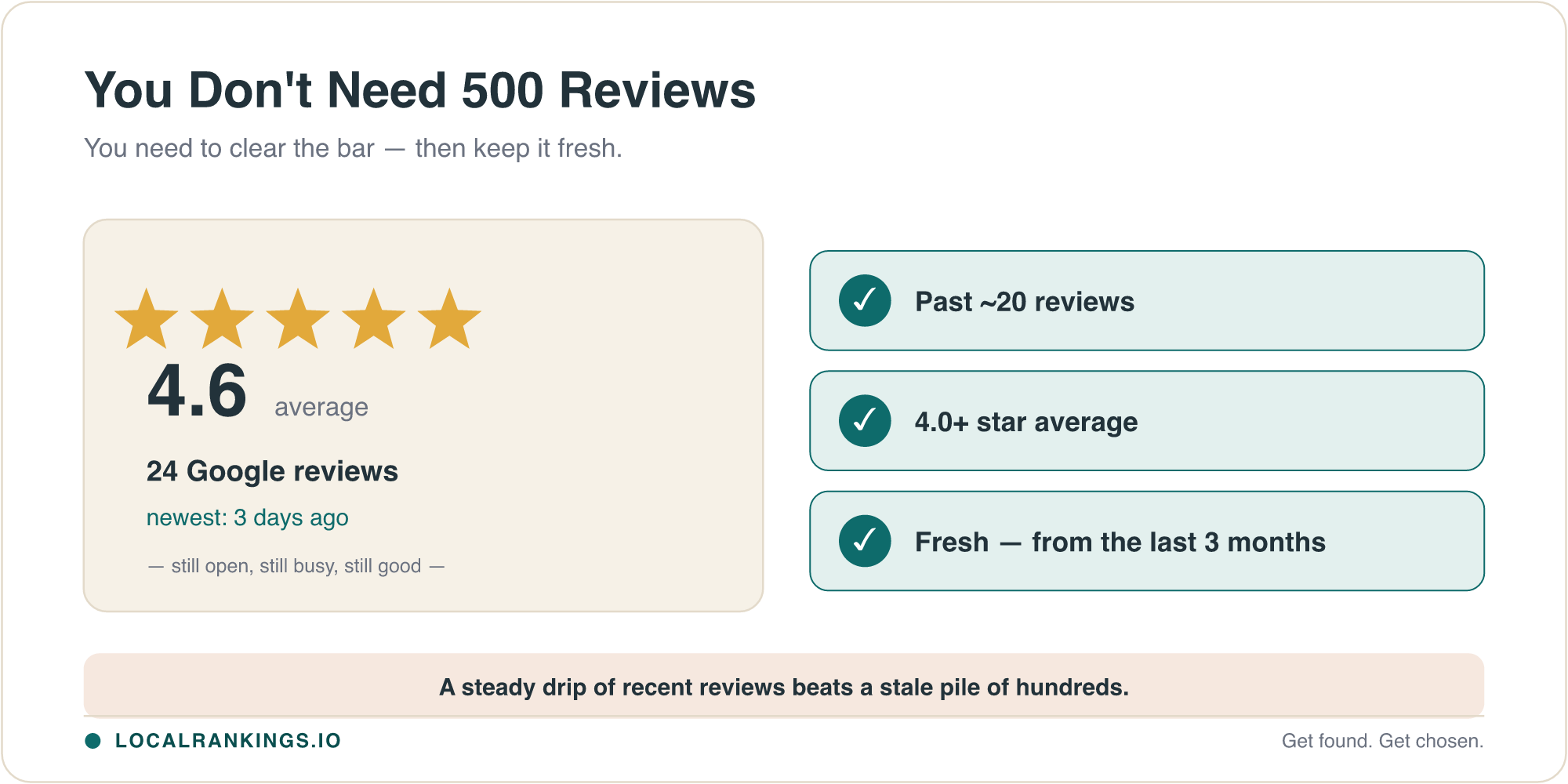
So the first half of the answer: enough to get comfortably past 20 reviews, at a 4-star-plus average. That’s not 500. For most local businesses it’s a few dozen solid reviews, a target you can actually hit this quarter.
The part everyone gets wrong: recency
A pile of reviews from three years ago doesn’t do what you think it does. BrightLocal’s data shows about 74% of consumers only pay attention to reviews from the last three months, and a chunk expect them as fresh as the last couple of weeks.
Reviews decay. A 5-star review from 2022 reads, today, like a business that was good once. To a customer scanning their options, and increasingly to the AI tools now summarizing those options, freshness signals that you’re still open, still busy, still good. That flips the whole goal. It’s not “collect a big number and stop.” It’s “keep a steady drip going, forever.”
So what’s the real target?
Put the two together and you get something honest and reachable:
- Get past about 20 reviews at a 4.0+ average. That clears the filter for most buyers.
- Then add a few every month, indefinitely, enough that your most recent review is always days or weeks old, not months. For a typical service business that’s two to four new reviews a month, which is completely doable if you simply ask.
Notice what’s not the target: 500 reviews, or beating the big franchise down the road. You don’t need to. A steady stream of recent 4- and 5-star reviews beats a stale pile of hundreds.
How to keep the drip going
- Ask every happy customer, at the right moment, right after the job’s done and they’re pleased, not in a newsletter three weeks later. A short text with a direct link works best. Make it a habit, not a once-a-year campaign: two a week quietly becomes a hundred a year, and it’s that steady rhythm, not the occasional push, that keeps you looking current.
- Make it one tap. Every step between “I’ll leave a review” and the review actually posting loses people. Hand them the direct Google link, not a homepage.
- Respond to all of them, good and bad. BrightLocal consistently finds people far prefer a business that replies to its reviews over one that ignores them. A calm, human reply to a 1-star does more good than the bad review does harm.
- Never buy or fake them. Beyond breaking Google’s rules and being easy to spot, fake reviews are exactly the kind of shortcut that blows up trust permanently. Real and steady beats big and fake every time.
Does it have to be Google?
Google is where the volume and the visibility are, so it’s where the bulk of your effort should go. Your Google rating is what feeds your map-pack ranking and the AI answers most directly. But a handful of reviews on the platforms your customers actually use (Facebook, an industry-specific site, even Yelp if it matters in your trade) help too. Part of why is consistency: a business that looks well-regarded everywhere someone might check is easier to trust than one with a great Google page and tumbleweeds everywhere else. You don’t need to chase all of them, though. Pick Google plus the one or two platforms that matter in your world and keep the same steady-drip habit there. Spreading yourself thin across ten review sites you’ll never maintain is worse than owning two.
The bottom line
You don’t need a wall of hundreds of reviews. You need to clear the trust bar (past about 20, above 4 stars) and then keep a steady trickle of recent ones coming so you always look current. It’s less work than chasing a giant number, and it’s worth more.
That steady drip is one of the highest-leverage things a local business can do. It feeds your Google ranking, your map-pack visibility, and now the AI tools deciding who to recommend. If keeping it going keeps falling off your plate, managing reviews is part of what we do, and a free audit will tell you exactly where you stand today.